Improving Interview Samples
One of the most important elements in empirical research is the sample. We learn about the world by analyzing pieces of it and as such, a study's claims are only as good as the sample on which it is based. This dictum is particularly relevant for interview-based research, which – though invaluable for the social sciences – is often accused of suffering from poor samples that cast its findings into doubt.
Building on the work of interview-based researchers, Assistant Professor Josef Woldense (African-American and African Studies) and Associate Professor Jane Sumner (Political Science) are working on a project called “A Network Approach to Better Understand and Evaluate Interview Samples,” that seeks to remedy this problem. Treating University of Minnesota students as interviewees, the goal is to discover their knowledge of the campus while also uncovering the latent network they are embedded in. Once the two are linked – i.e., knowledge of campus and latent network – the researchers can model the sampling process in ways that have thus far been elusive. This will offer researchers a better means to understand and evaluate interview samples.
This project recently received a DSI Small Seed Grant. The Seed Grant program is intended to promote, catalyze, accelerate, and advance U of M-based data science research so that U of M faculty and staff are well prepared to compete for longer term external funding opportunities.
The program was updated in Summer 2024 to include three focus areas: Foundational Data Sciences; Digital Health and Personalized Health Care Delivery; and Agriculture and the Environment. This project falls under the Foundational Data Sciences focus area. The types of awards are Rapid Response Grants and new types, Awards for DSI Faculty Fellowship and Data Sets (Data as an Asset).
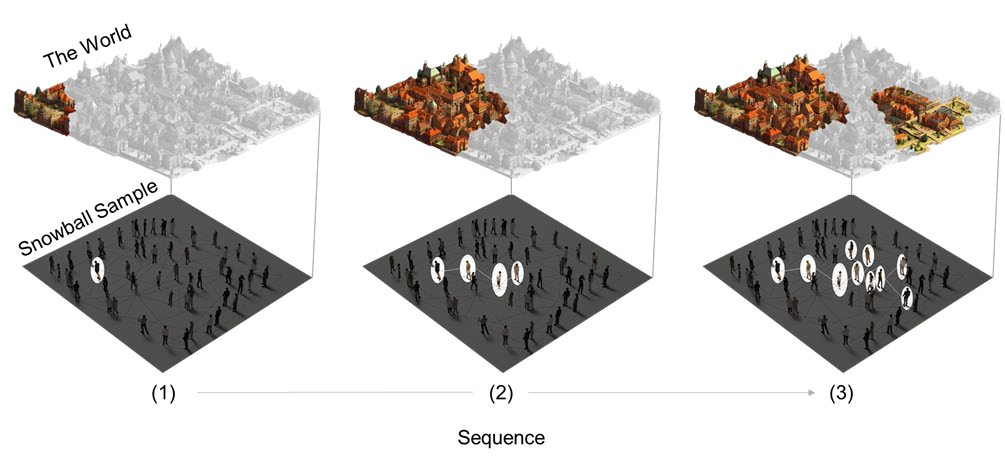
Image description: The relationship between snowball sampling and world building. Snowball sampling has become the bedrock for interview-based research. But how does this sampling strategy impact world building? The world and its inhabitants are modeled as existing on two parallel planes. The researcher recruits the first interviewee who shares their knowledge of the world and thereby illuminates it for the researcher. How much and what parts of the world are revealed will vary across interviewees. Some will know more and others less; some may overlap in what they reveal. The referral from this initial recruit then moves the researcher to the next set of interviewees, who in turn provide their knowledge of the world with the potential of illuminating more parts of it previously unknown to the researcher. This process continues until the researcher concludes the search for more interviewees. The two parallel planes are thus intertwined. The way the snowball sample unfolds shapes what parts of the world are illuminated.